But just below the surface were also the simmering dangers. Generously
buttressed by the Soviet Union, Somalia, which had territorial claims
over a fifth of Ethiopia’s land mass, was building a large, highly
mechanized modern army — one clearly intended for a Blitzkrieg in the
eastern lowlands. And Ethiopia was lagging badly. (Three years later,
a confident, militarized Somalia struck taking advantage of the
disarray at the center.) Haile-Selassie was on the verge of senility;
his designated successor was incapacitated by a stroke; and,
fatefully, there were no strong hands to stir the reigns of
government. The regime was visibly drifting.
A month later, in February, the implosion of a new dawn, unsolicited
and unorganized, caught the nation utterly unawares. The catalyst:
news of devastating famine in the north and the oil-shock of 1973 and
1974, which eventually quadrupled prices and triggered unprecedented
inflationary pressures. Between February and June 1974, broad
lawlessness engulfed the nation, threatening an outbreak of anarchy.
No civilian government was able to assert authority. To avert chaos,
intervention by the army was only inevitable and necessary. And it
came (officially) on 28 June 1974 (they had been organizing covertly
and half-heartedly for weeks.) A hundred and nine representatives of
the nation’s 40 armed units, ranging from privates to majors (higher
ranking officers were barred), convened in Addis and established the
“Derg”, “Committee” in Geez, once Ethiopia’s dominant language but now
spoken only by the Orthodox clergy. To chair them, they opted for
Major Mengistu Haile- Mariam, in deference to the primacy of the
second division, then the nation’s most powerful, which he
represented. No less, his humble background and dubious ethnicity
conveniently personified the revolutionary spirit of the times.
Two and a half months later, the Derg had deposed Haile-Selasssie, on
September 12, 1974, and imprisoned the entirety of the regime’s
civilian and military leaders promising “change without bloodshed.”
Three days later, it renamed itself the Provisional Military
Administrative Council and formally assumed state power under a new
chairperson, Lt. General Aman Andom. But as soon as the proud General
learned — much to his outrage — that the Derg only intended him as a
figure head, while real power still lay with Major Mengistu, a
showdown was unavoidable.
Ninety tense days later, the Derg, incensed and intimidated by Aman’s
refusal to play along, settles on showing — to friend and foe alike — who
really was in charge. And tragically, when nothing more than a simple
dismissal of the General would have sufficed (as one of
Haile-Selassie’s senior officials, Aman posed no real danger), the
Derg succumbs to inexplicable hysteria and opts for a massacre,
foolishly, and with no apparent due cause, reversing its “no
bloodshed” promise to the nation. Along with Aman, his close
associates and bodyguards, more than 50 other senior Haile-Selasssie
officials were brutally murdered and all buried in a mass grave. The
nation was literally stunned in to outraged silence. Not even the
harshest critics of the fallen regime approved.
The backlash was soon in full motion. Scores of opposition groups
sprang up, and suddenly, the nation went from no opposition to host of
the largest number of political organizations in Africa. Oppression
bred resistance, not the hoped for submission. And resistance
disastrously bred even more bloodshed. The low-point came three years
later, in February 1977, when Mengistu, no more hindered by moderate
Derg members (Brigadier General Teferi Banti et al), whom he had just
eliminated in a palace-coup, proclaimed the advent of “Red Terror” in
response to the “White Terror” of the Derg’s most adamant opponent,
the EPRP.
The concept of Red and White Terrors was imported from the early days
of the Russian revolution, which had resulted in a civil war. Both
sides in that war — Red Communists and White Non-Communists —
embraced violence as a vital political weapon, calculating that it
would be indispensable to an eventual victory. Leader of the Whites,
Lavar Kornilov, for example, instructed his army to “set fire to half
of the country and shed the blood of three-fourth of all Russians.”
He even ordered the death of “all workers.” The Communists were no
less apocalyptic. Explaining the Red Terror in an newspaper article in
1918, they said : “Do not look in the file of incriminating evidence
to see whether or not the accused rose up against the Soviets with
arms and words. Ask him instead what class he belongs, what is his
background, his education, his profession. These are the questions
that will determine the fate of the accused. That is the meaning and
essence of the Red Terror.” At least 10 of Russia’s 100 million people
must be “annihilated,” proclaimed Communist leaders openly.
In Ethiopia , the Derg and its civilian allies, clearly inspired by
the precedent set in revolutionary Russia, publicly vowed “to avenge
the (lost) life of one revolutionary with the lives of a thousand
anarchists(EPRP members).” Following up on their threat, thousands of
officials (kebele administrators and Revolutionary Guards throughout
the country) were armed and bolstered with a government issued
“license to kill (netsa ermeja)” edict.
For six infamous months (between February and August), alleged EPRP
members, many of them teenagers (some barely in their mid-teens), were
hunted mercilessly and summarily executed. Those who escaped execution
were imprisoned and mostly tortured. In the end, patently amateurish
EPRP death-squads, whom Mengistu had fantastically equated with
Korilov’s huge White Army, were to gun down less than 150 officials
(the exact figure is disputed), to which the Derg and its civilian
allies responded disproportionately with numerous human rights abuses
and thousands of executions. But exactly how many thousands will
remain as elusive—and controversial—as ever. (Amnesty
International’s estimate of 500,000 deaths, however, is grossly
exaggerated. Most of the killings happened in Addis, whose population
was roughly one million back then.)
An ever expanding capacity for incomprehensible violence characterized
the Derg’s reign right up to the end. Between the end of the Red Terror
and its demise in late 1991, for example, the imprisoned Ethiopian
Orthodox Patriarch, Abune Tewflos, was pitilessly strangled to death
(with lead wire), and Mitsewa and Hawazen were wantonly bombed by the
Air Force, despite the absence of a compelling military target on the
ground.
No amount of violence, however, was able to prevent the downfall of
the Derg. The end came after seventeen long years, in May 1991,
ironically, courtesy of not the political groupings it had feared but
from the midst of the political underdogs. Stunned by a defeat that
was never supposed to happen, Derg officials, whose larger than life
reputations had become part of the public legend, stood humbly in line
to give themselves up to the victors. No sight — before or
since — amazed the public more. Only one of the 109 members of the
Derg, General Haile Melese, defied the new regime by melting into his
home region — rural Gonde — and trying to organize an armed resistance.
(Hampered by old age and lack of external support, he was doomed
almost from the start. He now lives in New Zealand. His valor,
however, still stands in sharp contrast to his comrades.)
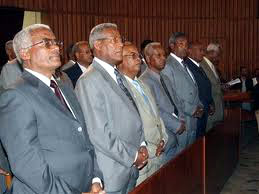
And for the past twenty years top Derg members have remained in
prison, reflecting on their past and the terrible consequences of
their reign (Eritrea seceded, too.) Their controversial(for its delay
and charge of genocide) trial lasted more than twelve years,
culminating in the death sentences of 18 of them: Colonel Mengistu
Haile Mariam, Captain Fikre Selassie Wogderes, Colonel Fisseha Desta,
Major Berhanu Bayeh, Captain Legesse Asfaw, Major Addis Tedla,
Lieutenant Colonel Endale Tessema, Captain Gessese Wolde-Kidan,
Major-General Wubshet Dessie, Major Kassaye Aragaw, Colonel Debela
Dinsa, Captain Begashaw Atalay, Second Lieutenant Sileshi Mengesha,
Colonel Nadew Zekarias, Lieutenant Petros Gebre, Second Lieutenant
Aragaw Yimer, Major Dejene Wondimagegnehu, Lieutenant Desalegn Belay.
And now, as 2003 Ethiopian Christmas approaches (about two weeks from
today), more than 37 years after the dramatic events that
inadvertently propelled them into the pages of history, they are
seeking the nation’s absolution. Inevitably, emotions have stirred.